Hours
Wednesday – Saturday 10am to 4pm
Sunday Noon to 4pm
The museum is closed on all major holidays.
Admission
Adults: $10.00
AAA Members: $9.00
Children 7 - 16: $5.00
Children 6 & under: FREE


“Tuned to the Past: The Field Family’s Musical Instruments”
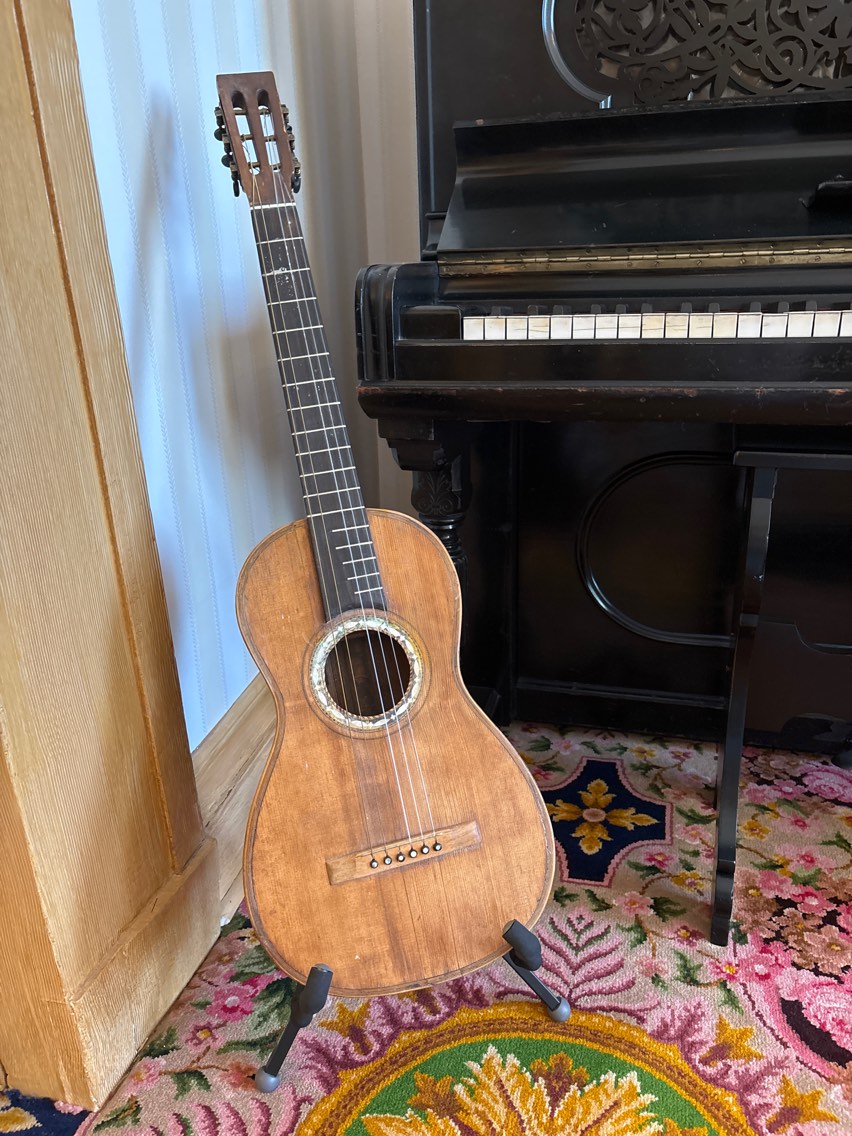 Music was a significant part of Victorian life, and that was certainly true for the Field family. Several unique and beautiful instruments were owned personally by family members, including guitars and pianos.
Eugene’s guitar, made of wood, brass, and mother-of-pearl detailing around the mouth, sits in the living room of the Field House. It is a Washburn style, a company that still exists and continues to produce guitars and other acoustic string instruments, such as banjos and mandolins. The frets shorten in length until they disappear at the mouth. The guitar has no position markers inlaid on the neck, which puts it in line with other instruments of that era, as position markers are usually found in instruments made after the 1950s. If you notice that the tuning keys of the instrument are found on the underside of the head, near the base of the neck, it might seem odd, as most modern guitars have them sticking out to the side. This may seem like a stylistic change, but it actually makes the instrument easier and more accurate to tune.
To pay back some debts Eugene had accumulated, he sold the guitar with the intention of repurchasing it when he had more money. A century later, the guitar was purchased by Phi Delta Theta, Eugene’s fraternity, which donated it to the Field House Museum in 1972. It’s one of the museum’s most personal items.
There are two pianos in the Field House: one is a large square grand, the other a smaller vertical grand, both of them manufactured by the prestigious piano company Steinway. The vertical grand was created in 1891, a Vertigrand Model K that was bought by Eugene for 200 dollars, which is about 7,300 dollars today. It has two brass pedals and is made entirely of a dramatic black wood. Eugene Field was known to sing uproariously while he played at this piano. In 1936, it was loaned to the Field House Museum by Eugene’s grandson, Frederick, and is now a permanent piece in the collection.
With a guitar and a piano, Eugene Field was more than a master poet and writer; he was a veritable jack-of-all-trades entertainer. On your tour of the Field House Museum, look around for his instruments and imagine what it might have been like to see him perform for a group of guests.